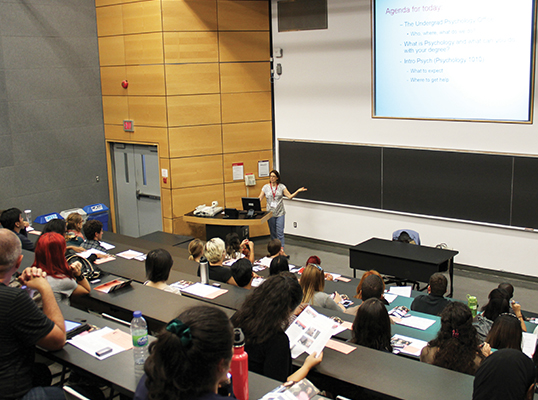

History and Systems in Psychology
PSY 718 (2 credits)
Prof. Jan Yoder (330) 972 - 8371
Department of Psychology
University of Akron
Akron, OH 44325-4301
Required Materials
A list of references to construct a book of readings is attached.
Course Objectives
Historians of psychology assert that how we view our history influences how we do psychology in the present and think about its future. The traditional approach to history acknowledged "great men's" contributions and described history as a progression toward increasingly accurate portrayals of truth. After briefly reviewing this positivist approach to understanding psychology's history, we will challenge this construction and offer a transformed vision of psychology based in social constructionism and the "new, critical" history. Much of this critique and re-framing of our history in this course will be approached from a feminist perspective.
Assignments and Grading
There are three graded components:
(1) key statements and questions for 12 class sessions (60% of one's final grade);
(2) class participation (10%); and
(3) (10-15 page paper (30%) (included in this grade is a proposal).
Key Statements and Questions. There are 12 class meetings (Sept. 14-Nov. 30) with assigned readings which we will discuss in seminar. For each of these 12 classes, you will compose: (1) 3-5 key statements and (2) one speculative question.
Key statements are 1-2 sentences that capture the basic points of the assigned readings.
Speculative questions go beyond the materials read to ponder integrative links among readings, extrapolations beyond the author's points, applications to real-life settings or needs, etc. The purpose of these is to reflect your understanding of the readings, stimulate thought, question concepts, and go beyond the materials presented; they are not meant to elicit simple regurgitation of the materials (i.e., they are not traditional exam questions). Please type your statements and question and bring enough copies to class to share with all class members. These questions will help focus our discussion on each on these class days.
Class participation. Successful graduate seminars depend on members' preparation and willingness to discuss in class. Group exchanges often take individuals beyond where we each would go alone. I am looking forward to active, questioning class discussions throughout the class.
Paper. The final 10 page, typed paper (preferably in APA format) will trace the history of a psychology of women topic of your choosing. It is due to me by Wednesday, December 16 before 5 PM. I encourage you to select a topic related to your own area of research. I must approve a 1-paragraph proposal by no later than October 19 (points will be deducted from the final grade for this paper if a proposal is not handed in and approved). The proposal will outline the topic you intend to pursue and list 2-3 citations that you expect to be relevant to your project. Your history must span at least three decades. Your paper will: (1) describe changes in how the topic has been approached; (2) cite major works, both theory and research, that illustrate the dominant approach at each time period; (3) speculate about reasons (academic, political, etc.) why the paradigm shifted; and (4) bring in class readings and discussions where appropriate. (I expect you to find some of what we discussed in class regarding the social construction of history to be played out in your specific area. Be sure to highlight or challenge this in your paper.) Your topic must fall within the psychology of women, that is, it must focus on how psychologists have studied and theorized about women and women's experiences. Some suggestions include, but are not limited to: the education of women and co-education, menstruation and/or PMS (now PDD), male violence against women (formerly masochism), intelligence, motherhood, women's sexuality, masculinity-femininity, androcentricism (putting men at the center of theory and research), definitions of women's mental health, changes in the DSM, causes of sex/gender differences, and women's leadership/achievement.
I put two articles on reserve on the library that have taken this approach. They may be useful models, but note that I do not expect your work to be as extensive (thus the 10-15 page limit).
Ashmore, R.D. (1990). Sex, gender, and the individual. In L.A. Pervin (Ed.), Handbook of personality: Theory and research. New York: Guilford.
Shafter, R. (1989). Women and madness: A social historical perspective. Issues in Ego Psychology, 12(1), 77-82.
Older articles will be harder to find because they won't be listed in CD-ROM abstracting services. You may find secondary sources useful starting places (for example, you may check what current papers are citing and work backwards and/or look for review articles, such as can be found in the Annual Review of Psychology and Psychological Bulletin, and trace their sources). You may have to resort to using the old hardcopy catalogues of Psychological Abstacts. You also may require requests from the library's archives and inter-library loan so plan for some delays. Play with your ideas and have some fun with this assignment.
Final grades will follow the standard pattern of 93% and above=A;
90%=A-; 87%=B+; 83%=B; 80%=B-; etc.
Class Schedule and Readings
Aug. 31 Introduction
Sept. 7 Labor Day--NO CLASS
Sept. 14 Positivism and Psychology's Challenges
Capretta (1967)
"Great Men" Boring (1950)
Boring (1951)
O'Donnell (1979)
Sept. 21 Re-defining Science
Kuhn (1962)
Danzinger (1994)
Sept. 28 Re-constructing History
Harris (1979)
Boring (1950)
Shields & Mallory
Oct. 5 Feminist Critiques Transforming Psychology
Weisstein (1992)
Sherif (1992)
Riger (1992)
Oct. 12 Social Constructionism and the "New History"
Furumoto (1992)
Bohan (1990)
Oct. 19 Feminist Frameworks
Lerner (1992)
Crawford & Marecek
Oct. 26 Inclusive Inclusion
Yoder & Kahn
West & Fenstermaker
Nov. 2 Exceptional Women
Russo & O'Connell
Scarborough (1992)
Nov. 9 Creating a Scientific Community
Ostertag & McNamara
Denmark & Fernandez
Nov. 16 Feminist Transformations: Counseling & Clinical Health Psychology
Gilbert & Osipow
Marecek & Hare-Mustin
Travis et al.
Nov. 23 Bandwagon Concepts
Mednick (1989)
Nov. 30 Future Projections
Mednick (1991)
Dec. 7 Discuss papers
*All readings are available in the reader.
Readings
Capretta, P.J. (1967). History of psychology in outline: From its origins to present. New York: Delta. Pp. 47-59; 168-175; 129-168.
Boring, E.G. (1950). Great men and scientific progress. Proceedings of the American Philosophical Society, 94, 339-351.
Boring, E.G. (1951). The woman problem. American Psychologist, 6, 679-682.
O'Donnell, J.M. (1979). The crisis of experimentalism in the 1920s: E.G. Boring and his uses of history. American Psychologist, 34, 289-295.
Kuhn, T.S. (1962). The structure of scientific revolutions. Chicago, IL: University of Chicago Press. Pp. 1-9; 160-173.
Danziger, K. (1994). Does the history of psychology have a future? Theory & Psychology, 4, 467-484.
Harris, B. (1979). Whatever happened to Little Albert? American Psychologist, 34, 151-160.
Boring, E.G. (1950). A history of experimental psychology (2nd ed.).Englewood Cliffs, NJ: Prentice Hall. Pp. 559-566.
Shields, S.A., & Mallory, M.E. (1987). Leta Stetter Hollingworth speaks on Columbia's legacy. Psychology of Women Quarterly, 11, 285-300.
Weisstein, N. (1992). Psychology constructs the female, or the fantasy life of the male psychologist. In J.S. Bohan (Ed.), Seldom seen, rarely heard: Women's place in psychology (pp. 61-78). Boulder, CO: Westview. (originally published in 1968)
Sherif, C.W. (1992). Bias in psychology. In J.S. Bohan (Ed.), Seldom seen, rarely heard: Women=EDs place in psychology (pp. 107-146). Boulder, CO: Westview. (originally published in 1979)
Riger, S. (1992). Epistemological debates, feminist voices: Science, social values, and the study of women. American Psychologist, 47, 730-740.
Furumoto, L. (1992). The new history of psychology. In J.S. Bohan (Ed.), Re-placing women in psychology: Readings toward a more inclusive history (pp. 11-30). Dubuque, IA: Kendall/Hunt. (originally published in 1988)
Bohan, J.S. (1990). Contextual history: A framework for re-placing women in history of psychology. Psychology of Women Quarterly, 14, 213-227.
Lerner, G. (1992). Placing women in history: Definitions and challenges. In J.S. Bohan (Ed.), Re-placing women in psychology: Readings toward a more inclusive history (pp. 31-43). Dubuque, IA: Kendall/Hunt. (originally published in 1979)
Crawford, M., & Marecek, J. (1992). Psychology reconstructs the female, 1968-1988. In J.S. Bohan (Ed.), Re-placing women in psychology: Readings toward a more inclusive history (pp. 139-155). Dubuque, IA: Kendall/Hunt. (originally published in 1989)
Yoder, J.D., & Kahn, A.S. (1993). Working toward an inclusive psychology of women. American Psychologist, 48, 846-850.
West, C., & Fenstermaker, S. (1995). Doing difference. Gender & Society, 9, 8-37.
Russo, N.F., & O=EDConnell, A.N. (1980). Models from our past: Psychology's foremothers. Psychology of Women Quarterly, 5, 11-53.
Scarborough, E. (1992). Women in the American Psychological Association. In R.B. Evans, J.S. Sexton, & T.C. Cadwallader (Eds.), The American Psychological Association: A historical perspective. Washington, DC: American Psychological Association.
Ostertag, P.A., & McNamara, J.R. (1991). =ECFeminization=EE of psychology: The changing sex ratio and its implications for the profession. Psychology of Women Quarterly, 15, 349-369. (pages 349-355; 368-369 only)
Denmark, F.L., & Fernandez, L.C. (1993). Historical development of the psychology of women. In F.L. Denmark & M.A. Paludi (Eds.), Psychology of women: A handbook of issues and theories. Westport, CT: Greenwood. (pp. 17-22 only)
Gilbert, L.A., & Osipow, S.H. (1991). Feminist contributions to counseling psychology. Psychology of Women Quarterly, 14, 537-547.
Marecek, J., & Hare-Mustin, R.T. (1991). A short history of the future: Feminism and clinical psychology. Psychology of Women Quarterly, 14, 521-536.
Travis, C.B., Gressley, D.L., & Crumpler, C.A. (1991). Feminist contributions to health psychology. Psychology of Women Quarterly, 14, 557-566.
Mednick, M.T. (1989). On the politics of psychological constructs: Stop the bandwagon, I want to get off. American Psychologist, 44, 1118-1123.
Mednick, M.T. (1991). Currents and futures in American feminist psychology: State of the art revisited. Psychology of Women Quarterly, 14, 611-621.